
When Printing Equipment Goes Global, After-Sales Service Must Go Global Too
Hanrun Paper’s After-Sales Service and Technical Support System
Hanrun Paper does more than supply UV, DTF, sublimation and DTG printing equipment and compatible consumables. We deliver a measurable, traceable production-support solution built around equipment uptime (actual operating time ÷ planned production time × 100%). From remote response within one hour to on-site engineering support, and from ink-path cleaning to software-level program modifications, our goal is to help customers meet delivery commitments and minimize production downtime.
|
≤1 hour |
72% |
2–7 days |
100% |
|
Average response to urgent tickets via remote video support |
Routine issues resolved remotely, without an on-site visit |
Typical overseas on-site engineering turnaround |
First-visit resolution rate for on-site faults |
Note: The figures above are based on Hanrun Paper's internal after-sales service records. Response time, remote resolution rate and on-site service performance are calculated from selected service cases. Actual response and resolution times may vary depending on fault complexity, location and parts availability.
Production downtime is not always caused by equipment hardware failures. In industrial digital printing, delayed technical responses, communication barriers across time zones, software configuration issues and insufficient knowledge of printing processes can also interrupt production.
For overseas customers, resolving a technical issue may require more than replacing a component. It may involve checking the ink delivery system, adjusting negative pressure, optimizing RIP parameters or inspecting mechanical control programs.
Without timely and technically accurate support, even minor problems can develop into longer production interruptions.
Selling the equipment is only the beginning. What customers truly invest in is the service behind it.
To address these industry challenges, Hanrun Paper has established a dual-track after-sales service system combining 24/7 remote support with international on-site engineering assistance. This approach moves after-sales service beyond reactive repairs towards proactive operational support.
Hanrun Paper resolves approximately 72% of reported technical issues through remote support, reducing the need for overseas on-site visits.
Our technical team uses WhatsApp video calls and remote desktop access to diagnose equipment problems, adjust RIP parameters, check negative-pressure settings and analyze ink supply conditions.
For urgent production-stoppage issues, the average initial response time is within one hour. Routine troubleshooting involving color calibration, nozzle checks and software parameter adjustments is generally handled within 24 hours, depending on the complexity of the issue.

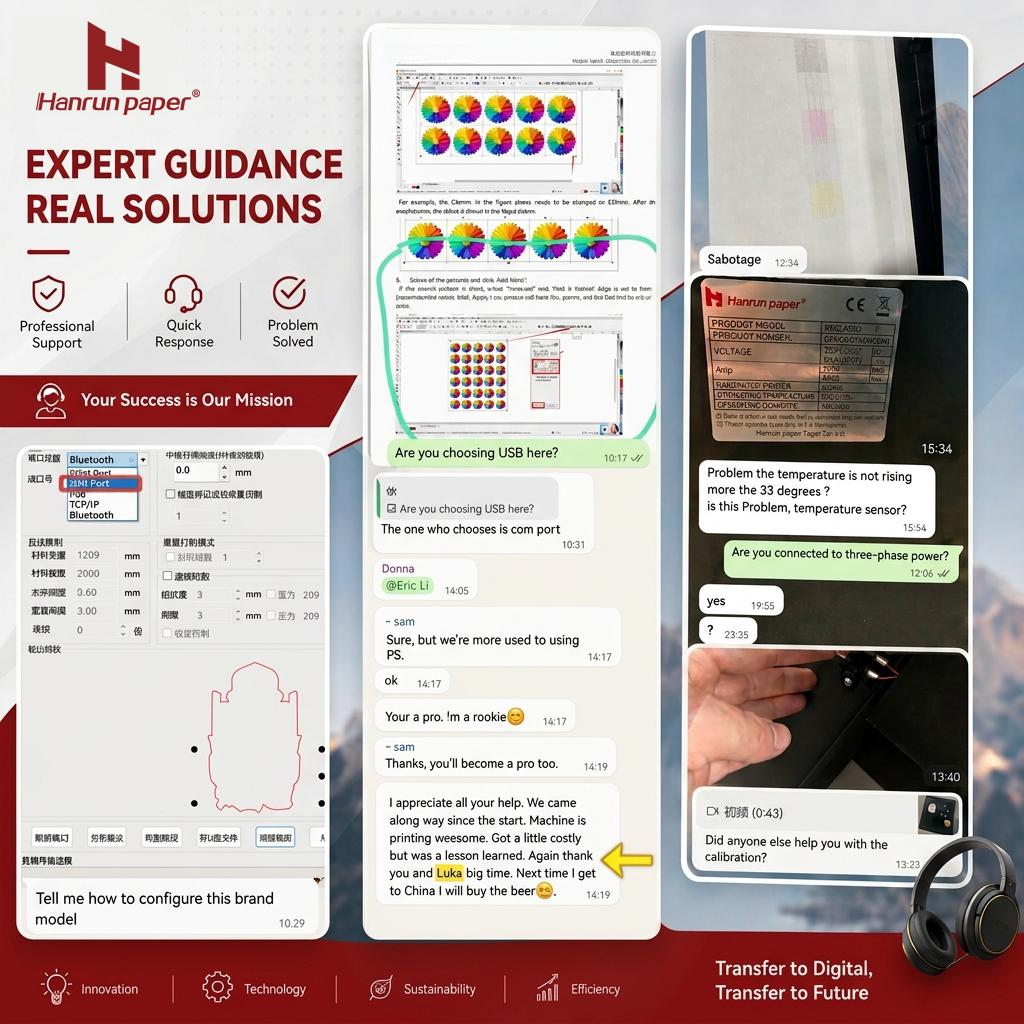
Our remote team can diagnose hardware and software together. Through remote desktop access, technicians can directly assist with RIP parameter adjustments, negative-pressure logic checks and ink-supply pressure analysis—instead of leaving customers to struggle through a manual on their own. This technical expertise is the foundation of our 72% remote resolution rate: remote support must understand the complete printing process, not just customer-service scripts.
When an issue cannot be resolved remotely—such as modifying a powder shaker’s mechanical structure, rewriting the underlying logic of a take-up system, integrating multiple machines on a production line, or replacing printheads and control boards—Hanrun Paper can dispatch engineers overseas as needed. These on-site cases are typically brought to closure within 2–7 days.
This year, Hanrun Paper has carried out more than 20 overseas on-site service visits. These have covered emergency repairs, production-line integration, program modifications, operator training and preventive inspections. The first-visit resolution rate for on-site faults was 100%, and customer satisfaction reached 100%.
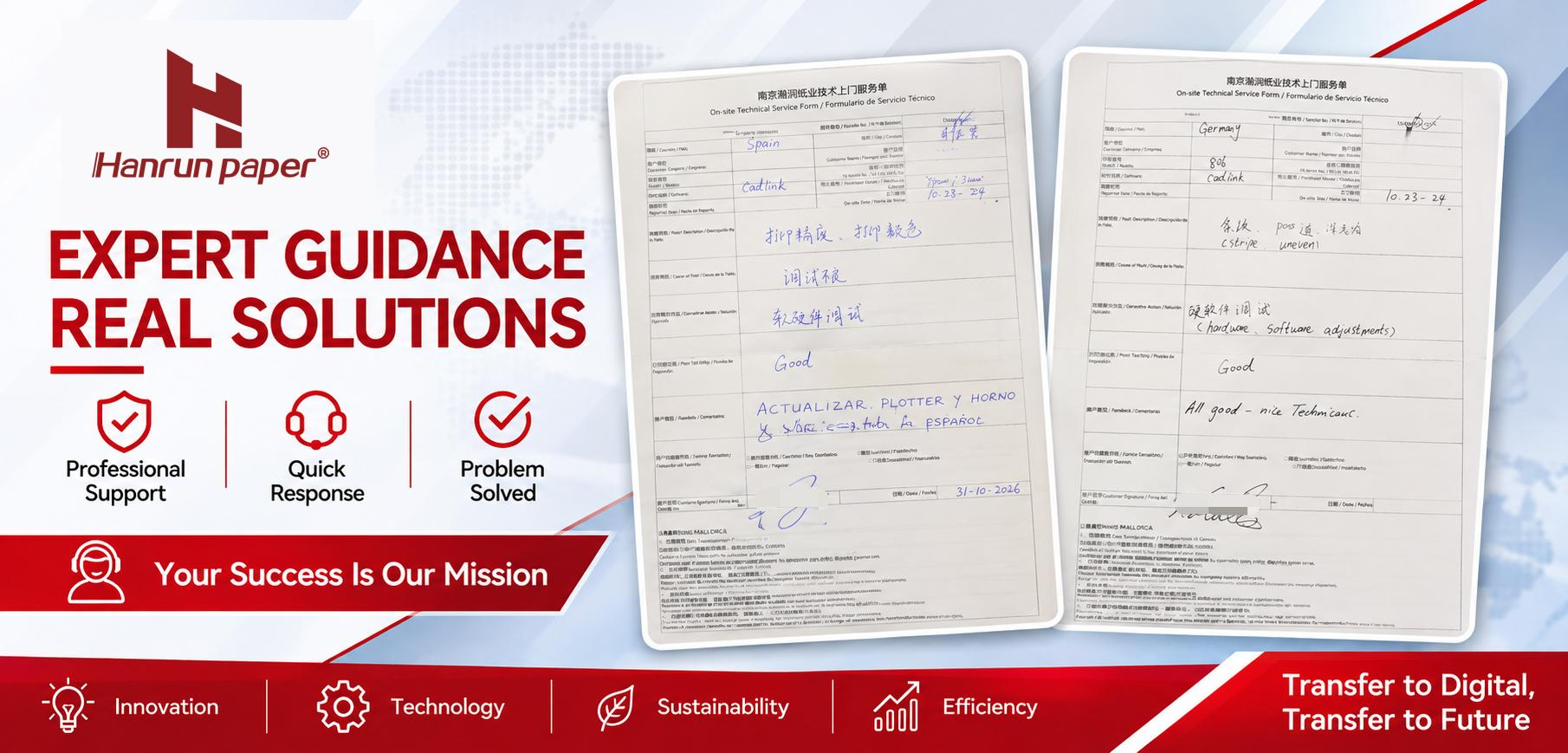
Our On-Site Service Methodology
An on-site visit is not simply a matter of sending someone to take a look. Our engineers travel with a structured diagnostic plan. Before departure, the likely fault area is assessed remotely. On arrival, the engineer follows the prepared action plan and checks each issue systematically. A printed test pattern is then used as the acceptance benchmark. A service ticket is signed off only when the test result is marked “Good.”
Hanrun Paper’s after-sales technical capabilities go far beyond basic machine repairs. They cover the complete technical workflow, from ink delivery systems to software-level control. The following breakdown is based on statistics from a selection of overseas service tickets:

Figure 1. Breakdown of Overseas Service Ticket Issues
Source: Statistics compiled from selected Hanrun Paper overseas on-site technical service reports and remote support tickets.
Print-quality issues account for the largest share of reported faults, but they are also among the easiest to treat superficially without addressing the root cause. Banding, ink dropouts and color shifts are often caused by interacting hardware and software factors. Checking only the printhead may not identify the cause, while parameter adjustments alone may not resolve the problem.
Hanrun Paper’s standard troubleshooting process addresses three areas together:
The key principle is to work with the customer’s existing consumables. Rather than asking customers to change consumables to suit the machine, we adjust the equipment to work with the consumables they already use—helping minimize switching costs.
2. Mechanical Structure and Program Logic: Hardware Changes Must Be Matched by Code Changes (21% of Reported Issues)
Powder-return blockages in powder shakers, irregular take-up signals and intermittent rear-blower operation are examples of issues that cannot be fully resolved remotely. Their root causes often involve both the mechanical structure and the underlying control program.
Hanrun Paper addresses these problems on both fronts:
Changing the mechanical structure without updating the program may allow the same fault to recur. Updating the program without correcting the mechanical issue leaves the hardware limitation unresolved. Both sides must be addressed together.
Burnt printheads and damaged control boards are irreversible failures that can result in significant downtime. Hanrun Paper aims to replace the ink-related components, control board and printhead in one coordinated service process, followed by full-machine commissioning. This avoids making customers wait for parts and schedule separate repair visits—each delay adds to production losses.
This is one of the areas where Hanrun Paper differs most from many suppliers. When an ink model may not be compatible, some suppliers simply suggest that customers try it on the machine, leaving the customer to bear the risk of printhead damage.
Hanrun Paper follows a controlled process combining staged compatibility testing, written risk disclosure and customer sign-off:
This is not just equipment repair; it is a way to protect the customer’s assets. A genuine Ricoh G6 printhead represents a significant investment, and sourcing a replacement can take 2–4 weeks. One unverified ink trial could therefore cost a customer far more than the price of a printhead.
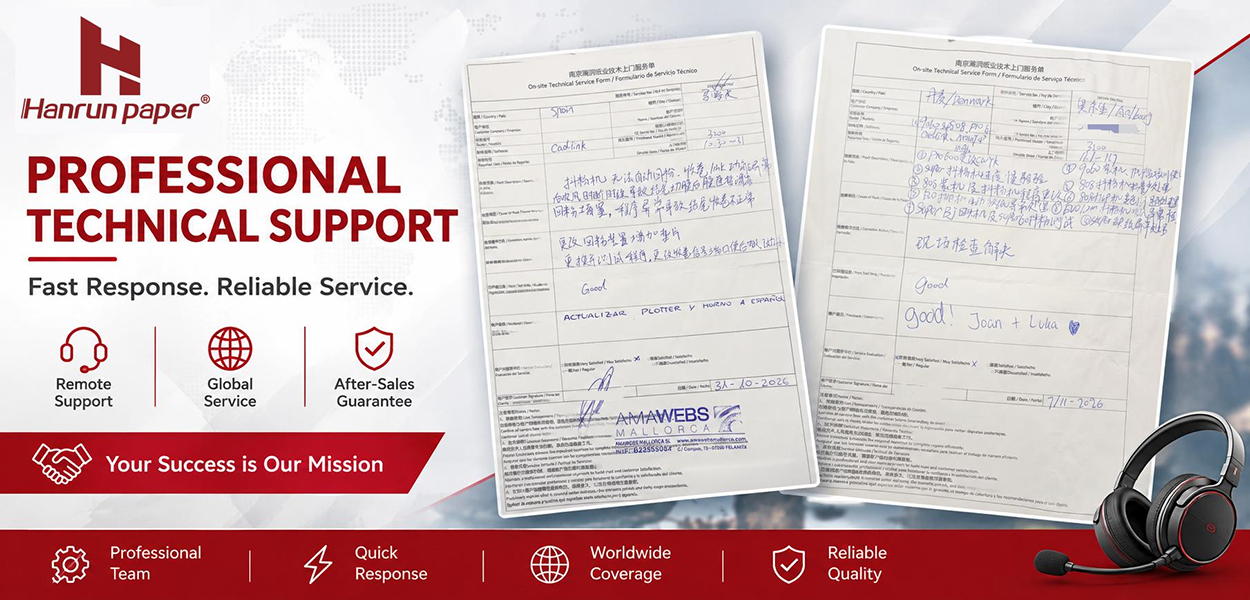
After every repair or adjustment, we require a printed test pattern and use it as the acceptance benchmark. A service ticket is signed off only when the test result is marked “Good,” helping prevent issues that appear fixed during servicing but return during production.
After every repair or adjustment, Hanrun Paper uses a printed test pattern to verify the machine's performance. A service ticket is closed only when the test result meets the required quality standard and is marked "Good."
Hanrun Paper retains multilingual technical service reports, customer feedback, signed acceptance records and dated test results. These documents help ensure that each service process can be reviewed and traced.
Repairing a machine solves the immediate problem, but it does not necessarily prevent the next stoppage. According to the data cited in this report, factories with in-house maintenance capabilities can reduce annual unplanned downtime by 30%. During every remote or on-site service engagement, Hanrun Paper also provides standardized training covering:
By teaching operators how to read test patterns and identify basic faults, many minor issues can be addressed before they stop production. Over time, this helps customers better control three major operating costs: wasted consumables, printhead wear and production downtime.
Training outcomes are reflected in customer service records. Feedback collected after on-site visits has included comments such as “Aprendimos mucho” (“We learned a lot”) and “Very good care and clean explanation.” These comments show that customers are not only confirming that the machine has been repaired; they are also confirming that they have learned how to manage it. Some customers have even requested localized equipment interfaces so that local operators can use the machines more confidently.
|
Comparison Area |
Typical Export Equipment Suppliers |
Hanrun Paper After-Sales Service |
|
Urgent service response |
Average response time of 48 hours; email exchanges and time-zone differences slow communication. |
24/7 cross-time-zone support; urgent tickets receive an average response within ≤1 hour via video. |
|
Remote troubleshooting |
Text-only guidance; complex issues are difficult to resolve. |
Remote engineers understand the complete printing process; 72% of routine issues are resolved remotely. |
|
On-site support for complex faults |
Scheduling often takes more than 7 days; some brands do not provide overseas on-site service. |
Engineers dispatched as needed; on-site cases typically closed within 2–7 days. |
|
Troubleshooting approach |
Addresses the immediate fault only. |
Integrated hardware repairs, program modifications, color optimization and production-line training. |
|
Proactive risk management |
Customers are asked to test consumables themselves, with printhead risks borne by the customer. |
Staged compatibility testing, written risk disclosure and customer sign-off. |
|
Preventing recurring faults |
No preventive maintenance training. |
Training is provided alongside service to improve customers’ ability to identify and resolve basic issues; the report cites a 30% reduction in unplanned downtime. |
|
Localization |
Not typically covered. |
Equipment interface localization to help local operators use the machines effectively. |
|
Service documentation |
No standardized service reports; limited after-sales records. |
Multilingual service reports, customer sign-off and retained test patterns provide a traceable service record. |
Source: Selected original Hanrun Paper overseas on-site technical service reports and remote support tickets from 2026.
Every machine supplied by Hanrun Paper is backed by ongoing technical support. From a remote response within one hour to on-site engineering support within 2–7 days, and from ink-path cleaning to program modifications, printed test-pattern acceptance and operator training, our commitment goes beyond repairing equipment. We help customers protect delivery schedules, reduce downtime losses and build the in-house capabilities needed to maintain stable production.

