
Every innovation starts with a different way of looking at a challenge. Behind a reliable printing machine is far more than hardware: it takes engineering expertise, precision manufacturing, and a continuous commitment to improvement. As digital printing technology advances, the ability to turn engineering insights into practical solutions is becoming increasingly important.
In this interview, we sit down with Eric, Senior Equipment Engineer at Hanrun Paper, to discuss the thinking behind the company's equipment development, the engineering challenges involved in building reliable printing systems, and how customer-driven innovation translates into better performance and greater operational reliability.
Innovation, precision, and reliability.
At Hanrun Paper, innovation drives technological progress, precision engineering enhances equipment performance, and reliable quality lays the foundation for lasting customer value.
Beyond developing and manufacturing individual machines, we focus on bringing printing equipment, consumables, and supporting technologies together to deliver integrated, one-stop digital printing solutions. This approach helps customers streamline production workflows, improve operational efficiency, and unlock new application opportunities.
When developing a new machine, how do you balance print accuracy, operating speed, equipment stability, and production efficiency?
We evaluate these factors together, setting key performance targets according to each machine's intended applications and specific customer requirements.
Different types of printing equipment come with different engineering priorities. UV printers place greater emphasis on structural rigidity, motion accuracy, and precise printhead control, while DTF and sublimation printers require particular attention to material feeding, tension control, and stable continuous operation.
We also place great emphasis on coordination among core hardware components. By optimizing mechanical structures, precision transmission systems, and motion control, we can minimize operational vibration and positioning deviations, helping ensure consistent and reliable machine performance.
This reflects Hanrun Paper's approach to equipment development: starting with real production needs and combining engineering expertise with practical design to create solutions that deliver reliable results in everyday production environments.
How does hardware design need to adapt to different materials, object sizes, and product shapes?
Hardware design must first address equipment adaptability, positioning accuracy, and operational stability.
Take Hanrun Paper's UV-H9060 Multifunctional Platform Lifting Printer as an example. Its height-adjustable platform accommodates objects of varying thicknesses, while its versatile printing capabilities support flatbed, roll-to-roll, cylindrical, and 3D printing applications. An optional cylindrical printing attachment further expands its application possibilities, allowing customers to print on a wider range of curved objects.
When working with materials such as metal, acrylic, glass, wood, and ceramic, we also need to take into account their surface properties, adhesion requirements, and specific printing processes. These factors help determine the appropriate print height, positioning method, and ink configuration for each application.
Our approach is to optimize the platform structure, motion control, positioning system, and functional modules as an integrated whole. This enables a single machine to accommodate a broader range of printing applications while maintaining consistent print quality and operational efficiency.
What do you think customers care about most when it comes to printing equipment hardware today?
Customers are primarily concerned with equipment reliability, production efficiency, and maintenance costs. They expect machines to deliver consistent performance, handle a wide range of orders, and minimize unplanned downtime.
Ease of maintenance and responsive technical support are equally important. At Hanrun Paper, our commitment extends beyond equipment development. We also provide professional training, operational guidance, and ongoing technical support to help customers keep their production running smoothly and efficiently.
Looking ahead, which will play a greater role in shaping the future of printing equipment: printhead technology, mechanical engineering, or overall system integration?
Competition in the printing equipment industry will increasingly be shaped by overall system integration. Printhead technology, mechanical engineering, and control systems all play essential roles, but a machine's performance ultimately depends on how effectively these core technologies work together.
At Hanrun Paper, we will continue to strengthen our equipment R&D, optimize core hardware configurations, and advance system integration capabilities. Our goal is to deliver digital printing solutions that offer greater reliability, broader application flexibility, and stronger overall value for customers.
What are some common misconceptions about printing equipment hardware that you still encounter among users?
One common misconception is that a better printhead automatically guarantees superior print quality. In reality, print quality is influenced by multiple factors, including mechanical design, motion control, ink delivery systems, and software calibration. All these components and systems need to work in harmony to achieve consistent results.
Another misconception is that a machine's initial performance is a reliable indicator of its long-term dependability. In practice, maintaining consistent performance over time requires not only high-quality core components but also effective system integration and proper maintenance.
Ultimately, combining well-engineered equipment with correct operating procedures and regular maintenance is essential to sustaining long-term productivity and maximizing equipment value.
What certifications or standards do professional buyers typically look for?
When evaluating a digital printing solution provider, professional buyers look beyond equipment performance. They also consider the company's quality management systems, product certifications, environmental compliance, and supply chain management capabilities.
At Hanrun Paper, we maintain high standards for product quality and regulatory compliance. Our printing equipment carries relevant CE certifications, including RoHS, MD, and EMC requirements, while our consumables meet applicable certification and standard requirements, including FSC and OEKO-TEX®. We also operate under an ISO 9001:2015-certified quality management system and an environmental management system.
In addition, we have established quality control procedures covering every stage, from raw material selection and production processing to in-process inspections and final product testing. We also pay close attention to equipment and consumables compatibility, using product testing and application validation to continuously improve the stability and reliability of our integrated solutions.
For Hanrun Paper, quality and compliance are not simply reflected in certificates. They are embedded in every stage of our equipment, materials, manufacturing, and service operations.
Can you share a challenging troubleshooting case and explain how you identified and resolved the issue?
Certainly. A customer once reported that the white ink output gradually faded and eventually stopped after approximately 20 cm of continuous printing.
We approached the issue through a systematic troubleshooting process, eliminating potential causes one by one.
First, we ruled out the ink itself, as the same ink performed normally on other machines. Next, we bypassed the machine's original ink supply lines and connected an external ink supply. However, the problem persisted, allowing us to rule out the internal ink tubing. We then swapped the printhead and printhead board with those from a machine operating normally, but the issue remained unchanged.
Eventually, we identified the third-party ink cartridge being used by the customer as the source of the problem. After removing the cartridge and connecting the external ink supply directly, normal printing was restored. Further testing confirmed that the third-party cartridge was restricting ink flow. Replacing it with a Hanrun Paper-supplied cartridge resolved the issue.
This case demonstrates the value of an integrated, one-stop solution. Ensuring compatibility between printing equipment and consumables helps reduce potential issues, maintain consistent print quality, and support reliable production.
BEYOND MACHINES. INTEGRATED SOLUTIONS. BUILT FOR THE FUTURE.
Behind every high-performance printing solution is a commitment to continuous innovation, engineering excellence, and customer success. As digital printing technology continues to advance, Hanrun Paper remains focused on developing more capable equipment, strengthening system integration, and enhancing the synergy between printing equipment and consumables.
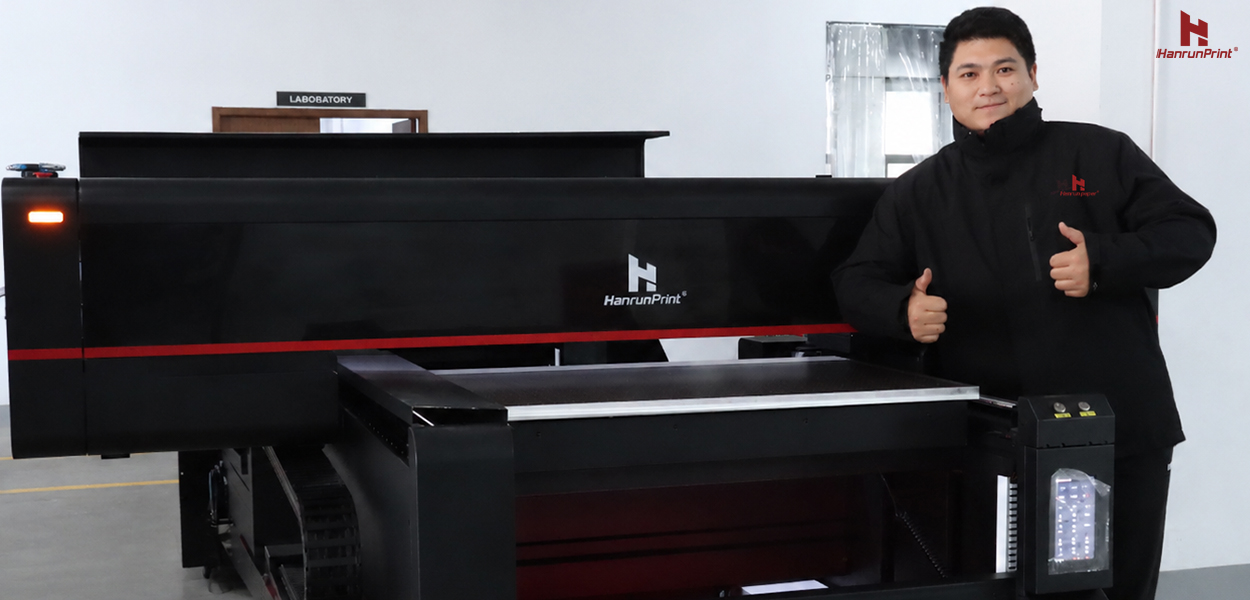
For us, innovation goes beyond building better machines. It means bringing equipment, materials, and technical expertise together to deliver integrated solutions that help customers improve productivity, expand their capabilities, and grow with confidence.

