Categories
The tips how to choose fabric for sublimation transfer printing
features of transfer printing fabric (fabric):
Sep 23rd,2017
2743 Views
The pigment or dye printing on paper, rubber or other carrier, then printing to be printed on the goods that transfer printing, transfer printing but the narrow sense refers to the textile printing technology as carrier.
Transfer printing is mainly used in polyester fiber products, and with the improvement of transfer printing, it has been widely applied in nylon, acrylonitrile, cotton, linen and woolen fabrics.
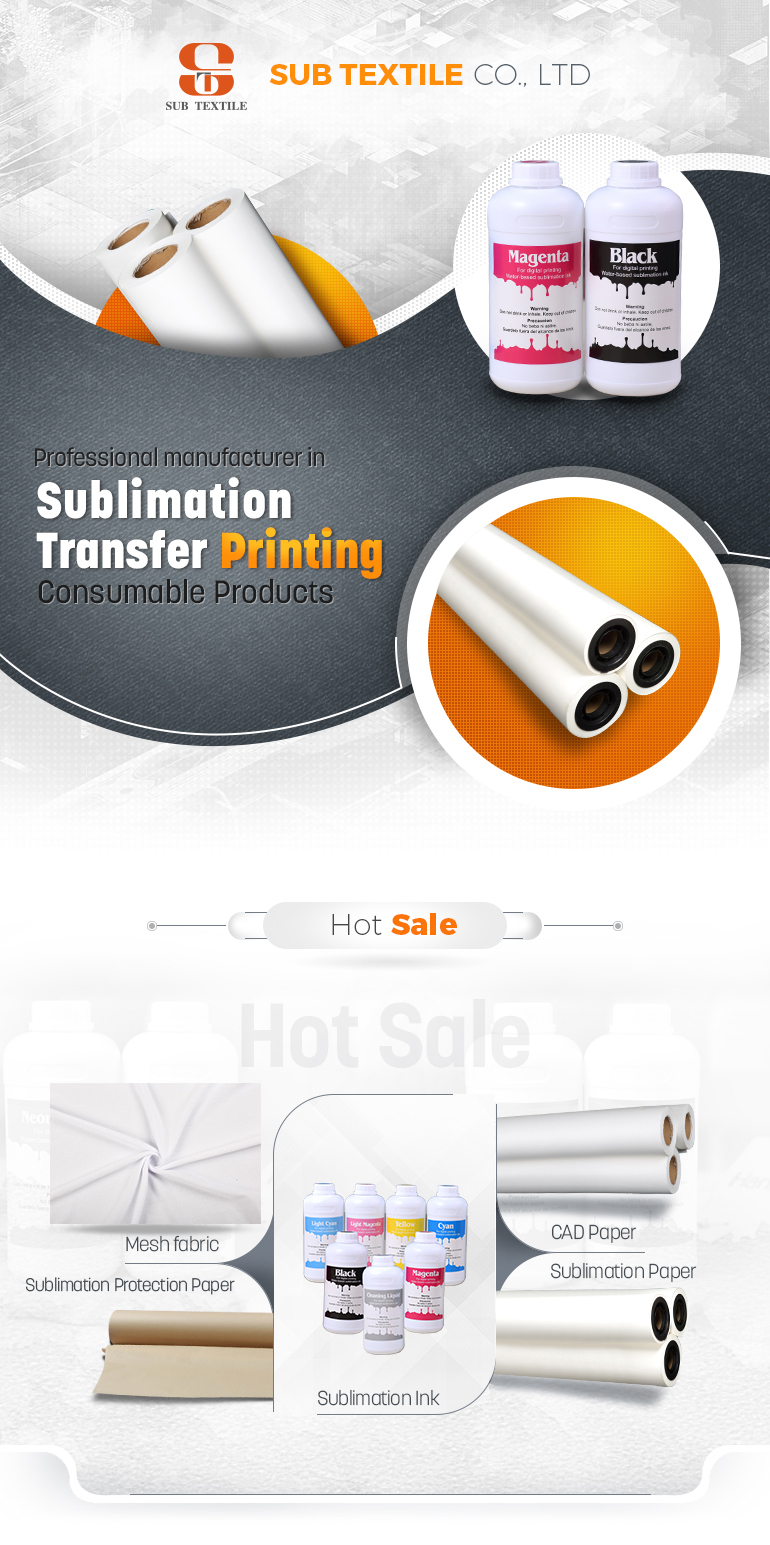 Transfer printing fabrics (fabrics) are divided into wet, dry, steam, vacuum, thermal and other forms. Transfer printing method can accurately reproduce the pattern for mechanized production, and has the advantages of simple process, especially the postprocessing process than the traditional printing dyeing and printing and dyeing the same simple handle, and gradually replace the old method of printing potential. But most printing and dyeing factories in China are still using traditional printing and dyeing process.
Only a few production units use transfer printing for production.
I. features of transfer printing fabric (fabric):
(1) the pattern of transfer printing fabric (cloth) has the characteristics of vivid flower pattern, exquisite pattern, clear layers and strong stereoscopic feeling. Transfer printing can print natural scenery and artistic patterns.
(2) transfer printing fabric (fabric) equipment has the characteristics of simple structure, small footprint, low investment and high economic efficiency. As the equipment is tension free processing, suitable for all kinds of thickness printing. In addition, the transfer printing process can be packaged without leaving the factory.
(3) there is no environmental pollution in transfer printing fabric (fabric). Due to the dry processing, without washing, steaming and drying, so there is no waste gas and waste water discharge.
(4) transfer printing fabric (fabric) has the advantages of high production efficiency, labor saving and easy operation. At present, a wide range of hot melt resin, in addition to polyester, there are polyamide, vinyl acetate copolymer and polyurethane. The main component of polyester hot melt adhesive is polyester resin, polyester resin is polybasic acid. Obtained by the esterification of polyols with polyols. Polyurethane hot melt adhesive has strong adhesive force, toughness, low temperature resistance and nylon fabric affinity.
It is suitable for preparing nylon transfer printing paper. Ethylene vinyl acetate copolymer has low melting point and strong adhesive force. It can be used to produce transfer printing paper after adding printing ink. Polyurethane hot melt adhesive is mainly used for leather and polyvinyl plastic bonding.
Transfer printing due to the printed fabric is different, it is best to use the appropriate hot melt adhesive ink.
Transfer printing fabric (fabric) knowledge brief introduction two, transfer printing fabric (cloth) the principle of transfer printing fabric (fabric) is used for polyester fabrics. It is a kind of printing method that uses the high temperature (about 200 DEG C) to sublimate the dye into the air, condenses it on the surface of polyester fiber, and then seepage to the amorphous area of the macromolecule, and then stays inside the fiber after being cooled. Three, transfer printing fabric (cloth) transfer of dye Disperse dye printing application requirements, the sublimation temperature should be lower than the fiber macromolecule melting point and does not damage the fabric strength principle, suitable for polyester processing temperature is 180--210 DEG C.
if you want to konw more, please
www.subtextile.com
info@subtextile.com


