Categories
Selecting the Best Ink for Wide-Format Printing
The first step in selecting a wide format printer is to determine the type of ink you wish to use.
Sep 24th,2021
1529 Views
The first step in selecting a wide format printer is to determine the type of ink you wish to use. Most printing machines are made to print on a certain type of material, such as paper or film, and to use the inks that are best suited for that medium. There are presently five main types of inks used in wide format printing, each having its own set of properties that influence the printer's design and, as a result, its cost, as well as the variety of materials and applications it can handle. As a result, one of the most important considerations a wide format business owner may make is the type of ink to use.
Most inkjet inks are made up of colored pigments contained in a carrier liquid that allows the ink to be jetted, as well as other additives that help the ink run smoothly and prevent it from drying up in the printheads. Every part of the printer is built for a certain type of ink, from the tubing that transports the ink from the tanks to the heads to the drying system and maintenance procedures, making it nearly hard to switch from one type of ink to another.
Solvent-based ink dominated wide format printing for many years because it was very inexpensive and adhered to practically any type of substrate. However, this is also an issue with solvents: when the solvent evaporates, it releases volatile chemical compounds into the air, which may cause significant health problems if inhaled over long periods of time. Ink manufacturers have responded by using less toxic solvents, albeit they are less effective. Because these inks are less expensive, they are referred to as eco-solvents.
 When it comes to hard materials, a flatbed or hybrid printer with UV-curable inks is the most popular choice for most individuals. Because this ink is extremely complicated, both the ink and the printers are usually fairly costly. The major benefit of UV ink is that it cures to a durable surface that can survive most outdoor situations without the need for further lamination. Foamcore, plastics, aluminum composite, and wood are among the substrates that the inks perform well with. Even better, the ink cures quickly, allowing the prints to be sold immediately after printing with no additional labor.
 Resin inks provide an alternative, and as more suppliers produce these inks and printers, they are expected to become more widely used. The pigment is encapsulated in some type of plastic or resin, such as latex, in resin ink. Heat is used to cure the ink, melting the plastic and attaching the pigment to the substrate while also providing a layer of protection for the pigment. This protection may be enough for outdoor display graphics, depending on how the ink is produced.
A family of aqueous inks that employ dye or pigment as the colorant is also available. Although they have a large color range, this ink does not have strong weather or UV resistance, thus it is best laminated for long-term interior usage and should be avoided for outdoor use.
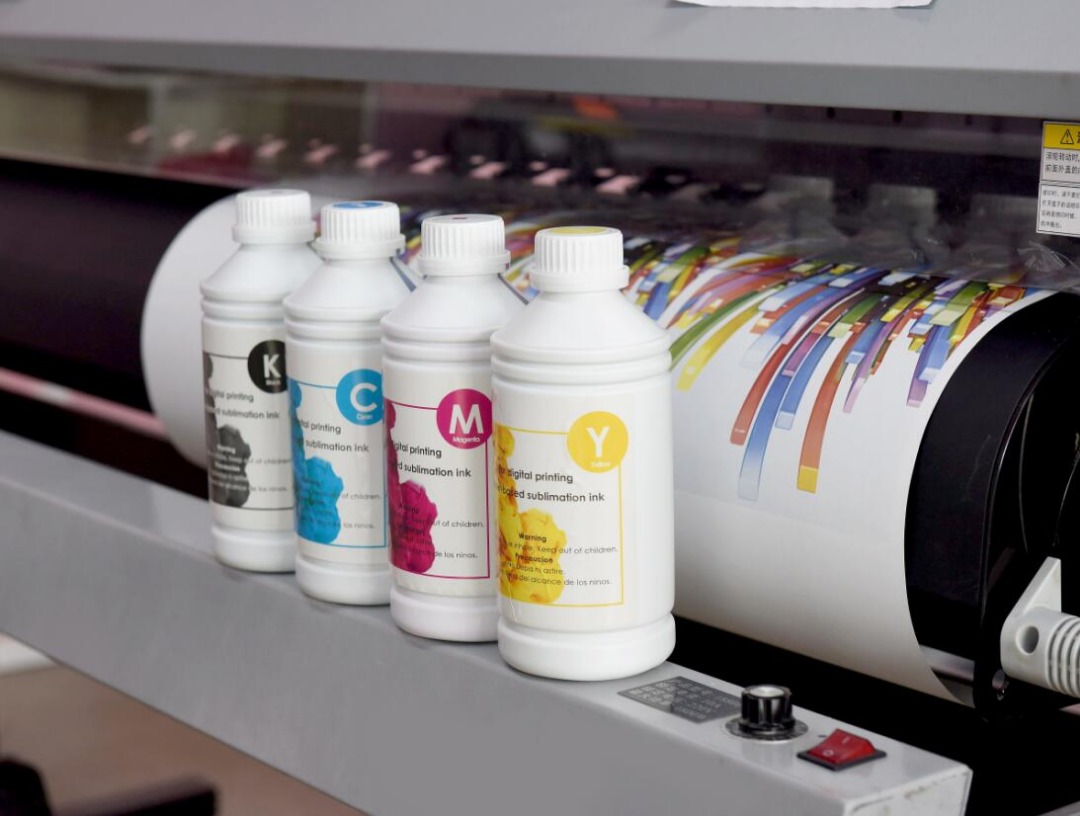
Finally, during the last 10 years or so, sublimation inks have grown more prevalent in wide format printing. These are water-based inks that can be used to print on polyester textiles or mixed fabrics that include at least 70% polyester. These fabrics have become the norm for most exhibition and retail work as a sustainable alternative to PVC for indoor graphics.
These inks may be printed directly on the fabric, although they're generally printed on sublimation paper for the greatest results, especially on clothing. The paper and fabric are then placed in a heat press machine, where heat and pressure are used to sublimate the inks, effectively heating the ink to a gaseous condition and then forcing it into the fabric's threads. When the ink dries, it forms a permanent connection with the cloth.
Hanrun paper have seen the potential of this market and now offer various sublimation ink to meet our customers’ needs. Subtextile specializes in providing you with sublimation equipment and consumables available in the textile field. Our ink is suitable for most large format sublimation printers and sublimation paper on the market.
The advantages of Subtextile sublimation ink:
Excellent fluency, no clogging no oblique spray, ink particles are evenly distributed and less than 0.3μm
Excellent color expression bring you amazing color performance
Perfect light fastness and washing fastness, no changing colors or fading, dry and wet rubbing fastness up to Grade 4-5
Environmentally friendly: Earn ECO PASSPORT by OKEO-TEX Certification
 Because these inks are drab when printed and only achieve their full color after sublimation, they do take some skill. You will also want a roller heat transfer machine or an oven for the sublimation process. This setup, on the other hand, may be used to make apparel and giftware, as well as display graphics.
Subtextile Co. Ltd.
Address:699-18 Xuanwu Avenue, Nanjing City, China, 210000
Because these inks are drab when printed and only achieve their full color after sublimation, they do take some skill. You will also want a roller heat transfer machine or an oven for the sublimation process. This setup, on the other hand, may be used to make apparel and giftware, as well as display graphics.
Subtextile Co. Ltd.
Address:699-18 Xuanwu Avenue, Nanjing City, China, 210000
Tel |Fax:+86 25 85416407 (GLOBAL)
Cell:+86 17798509616
Whatsapp:0086 17798509616
E-mail:info@subtextile.com


